The Language Debate
Tuesday, I attended a book release for “How I learned to Speak English” By Tom Miller. Miller rounded up 55 hispanic authors from all around the United States and told their stories through this novel. In the book release, Miller spoke mainly on how congress continues to ignore spanish speakers and continue to refuse to put both English and Spanish signs up, offer texts in both languages and things of that sort.
The stories the 55 authors told really showed how hard it is to learn English. This makes me wonder why it would be so hard to make the United States bilingual.
The cost of completely bilingual-izing America would be huge as everything would have to change, but this would certainly end the stigma that America only knows English. If America was bilingual it would certainly improve international relations, as foreignors could no longer accuse America of caring only about itself.
Specifically, this would create better relations with Mexico and South America, relations who as of recently have been quite strained. It is vital to have good relations with neighboring countries, and a bilingual America would certain show our spanish speaking southern neighbors a lot more respect that we currently show.
Personally, I feel the reason why America has refused to convert to bilingual system is because over the last decade the government has been mainly conservative. I feel with the growing rate of spanish-speaking immigrants, this law will be changed.
Radical Cheerleading: A New Means of Activist Expression
“Squad set?” yells Emily.
“YOU BET!” we respond.
She calls out the cheer and we begin. But this isn’t just any cheerleading squad yelling for their football team. We’re the DC Radical Cheerleaders and our chants have nothing to do with team spirit. We scream for stopping climate change, resisting capitalism’s domination, smashing the state, and liberating ourselves from patriarchy.
We don’t look like your typical cheerleaders either. We dress in full red and black. Instead of skirts and vests we wear leggings, t-shirts, dresses, and safety-pinned patches. We wear bandanas around our necks and write RC/DC proudly across our faces. And most of all, we are excited to cheer.
We assemble downtown on Saturday, September 15 to participate in A.N.S.W.E.R.’s March on Washington to end the war in Iraq. In solidarity with the many demonstrators, we circle up and begin to cheer. We begin with “George,” a crowd favorite that ridicules President Bush and the actions he carries out in the name of the “war on terror.”

GEORGE
Dub dub dub dub dubdubdubdubdubdub dubya bush
The shrub!
He says the war on terror
Will make the world fairer
But we know that he’s lying
‘Cuz we see innocents dying
Your civil liberties
He’ll take away
He’ll spy on you all night and day!
‘Cuz I’m a terrorist and you’re a terrorist
And she’s a terrorist and he’s a terrorist!
Its terror! AH! Its terror! AH!
But what is terror anyway?
Nuclear destruction
Genetically modified food
The IMF, the World Bank
It’s all bad news!
Damn, them fascists are some heavy, heavy dudes.
Resist, Resist
Raise up your fist!
Resist, resist
We know you are pissed
Resist, resist
Fight the capitalists
Resist, resist
Show ‘em what they can kiss! Uh!
Of course, no simple listing of these lines can do the cheer justice. Just imagine twenty women yelling, clapping, kicking, and moving. The energy, even on this hot afternoon, is contagious. Crowds gather around us as we cheer. They ask us who we are, because many of them have never seen a radical cheerleading squad perform before.
Conceived by three Florida sisters in 1996, the radical cheerleading movement has spread across the country and across the world. The first radical cheerbook, published as a zine in 1997, describes it as “activism with pom-poms and middle fingers extended. It’s screaming ‘fuck capitalism’ while doing a split.” It is a type of Guerilla Theater—attention grabbing and exciting. In the midst of a serious political demonstration, we energize people and provide entertainment. It’s a unique form of activism that’s empowering and fun.
Throughout the day we move through the crowd, performing many other cheers for our fellow protesters, including “Ugly” (about corporate greed), “Hot In Here” (against global warming, set to the tune of Nelly’s song Hot In Herre), and “369” (against the World Bank / IMF). Two other cheers, “Supersonic” and “Fraggle Rock,” are below. One of the highlights of the day was confronting the counter-protesters, the Gathering of Eagles. We were able do drown out their conservative chants with our radical cheers. We also took a break from cheering to dance along with the drum circle. Dancing is great for morale!
After a few hours of cheering and marching, the protest is over. We return to AU, tired but satisfied, and ready for the next action, rally, or demonstration where we can showcase our cheers.

SUPERSONIC
The D is for Deception
The U is for Untrue
The B is for BS, girl you know he lied to you
The Y is for Your war
A we Asked you to stop
The B is for the Bombs nobody asked you to drop
George Bush
Su-see ya later
The B is for our Bodies
The U is for Unique
The S is for Safe sex,
George you know the kids all freak!
The H for Human rights
And the M for My
The F for Feminism waving you buh-bye
George Bush
You motherfucker
Well…
Hey George Bush,
Can’t you see
That my body belongs to me!
FRAGGLE ROCK
(Set to the tune of the TV show’s opening song)
Take it to the streets
Revolution is so sweet
Something we expect
Is freedom and respect
So radicals of today
We need to find a better way
We need to have a say
Equality’s the way
So stomp and smash the state
It’s time for us to liberate
And Bush can go to hell
Rise up, resist, rebel
For more information on radical cheerleading, click these links:
http://en.wikipedia.org/wiki/Radical_cheerleading
http://radcheers.tripod.com/
http://american.facebook.com/group.php?gid=2228634443
Jimmy Carter on Darfur
[this post was originally written on October 25th]
I managed to get my hands on one of the elusive Jimmy Carter Engagement tickets and at 1:13 yesterday I saw the former president in person for the first time.
As he walks out on stage, I realize just how courteous, lithe and inspirational the man really is. He waves at us all, accepts the uproarious applause with grace, and of course starts with a joke –he’s already three times better than our current president. As he begins to dive into his speech, the recital hall falls wonderfully silent, save the sounds of camera flashes and shutters. Secret Service, Metro Police and Campus Security stand with their backs to the stage, watching the audience for potential security threats. Their presence isn’t enough to overwhelm the optimism of Carter’s speech, however.
He finishes his story about a New Yorker cartoon and the importance of being an activist ex-president and launches into a discussion on the involvement of the Carter Center in elections, leaders, food and mental health concerns in developing nations around the world. From there Carter speaks about The Elders: Kofi Anon, Nelson Mandella, Desmond Tutu and himself, among others –“political has-beens” he jokingly says. Burma, Zimbabwe and Darfur are the focal points of activism among The Elders. Carter then begins to speak exclusively on the topic of Darfur and the efforts he’s led through both the Carter Center and The Elders to raise awareness of the “crimes against humanity” occurring in Darfur and to “find permanent peace” between northern and southern Sudan. He rejects the term “genocide” in discussing the Darfur question because –he argues- “while the government is culpable” for the atrocities committed upon hundreds of thousands of Darfuris, “the government has not orchestrated [those attacks]”.
Within this very serious discussion, however, the climax of Carter’s speech comes when he says that the momentum of American foreign policy and international opinion of the United States can –and should- change within the half hour needed for a new Democratic president to deliver his or her inaugural address. Carter suggests that five things must be said. First, the new president must declare that the United States will no longer go to war unless there is a direct threat to our national security. Second: that we will no longer torture potentially innocent suspects and hold them accountable to American law without providing them with American rights – full, boisterous applause follows this pronouncement. Next, Carter calls for peace in the Middle East and an increased concern for the environment in “combating global warming”. Carter’s fifth and most important suggestion for the new president’s inaugural speech is a promise to “raise high the banner of human rights” –more applause follows.
On the whole, Carter’s speech reminds me of the importance of idealism in foreign policy: without hope for a better method of dealing with terrorists, ignorance, struggling economies and decreasing resources, what improvements in international relations do we have to look forward to in the future? What we need now is a president who can break us out of this self-destructive approach to foreign policy –power relations are immutable- and show us that there’s a better way to do business. We need a president who can unite our country socially (s/he must defend the humanity and equality between men and women of all sexual orientations) economically (s/he must refuse to sign resolution after resolution to send more and more U.S. money into the soil of Iraq and Afghanistan and instead funnel those dollars back into domestic programs) and politically (s/he must engender bi-partisan support for furthering social and economic equality at home and abroad). Perhaps with a president like that we may begin to solve some of the issues to which President Carter has devoted so much of his life.
Progress in Politics Forum
I’m sitting in the Butler Board Room at AU waiting for the “Progress in Politics Forum” to begin. The forum is sponsored by Women’s Initiative and Students for Hillary and will feature 3 AU professor panelists: Sarah Brewer, Allan Lichtman, and Barbara Palmer. According to the AU Student Government Web site, the forum “will examine and discuss the past, present and future of women in American politics from a historical, political and feminist perspective.”
These issues are important to expanding the diversity of political debate in America today. The increasing influence of women on the political process has the opportunity to transform political dialogue. This is especially relevant in light of Nancy Pelosi’s recent election to Speaker of the House and Hillary Clinton’s bid for the oval office in 2008.
The panel is beginning without Allen Lichtman, who failed to show up.
Director of Women & Politics Institute Karen O’Connor is moderating the discussion.
While the panel covered a broad range of topics from the first congresswoman (Jeanette Rankin, first elected in 1916) to the term of former supreme court justice Sandra Day O’Connor, I’d like to focus mainly on the panel’s discussion of Nancy Pelosi, Hillary Clinton, and the challenges facing women running for national office today.
Palmer discussed whether we, as a country, have gotten past referring to Pelosi as “Nancy Pelosi, the first female speaker of the house,” and now think of her only as “Speaker Pelosi.” Palmer said when a journalist recently asked her this question, she was inclined to say yes, we have gotten past it, but then she recalled an instance this past summer when the media had a ball covering Clinton’s cleavage. Often, the media will cover female politicians’ clothes and families far more than they will for male politicians.
I find this appalling, and really, really annoying. Focusing on personal matters and fashion choices obscures the real issues at hand. Though Brewer said in the panel that Clinton does not get as much of this because she has been on the national political stage for so long. However, women’s professional dress is a lot less standard than men’s (I guess a blue suit and red tie wouldn’t fly with Hillary. I know it wouldn’t with me!), so we have a lot more room to be creative. Of course, this can create a distinctive look that some wayward journalist might actually think is newsworthy
Back on Pelosi, Brewer said that it is her duality of female stereotypes that contributed to her success.
“She’s not the iron lady, but she’s not just the grandma that everybody likes,” Brewer said, citing Pelosi’s traditionally masculine approach to leadership.
“Don’t get me wrong, the fact that she’s a grandmother of five is the reason she can get away with this…. shes a great transitional person in my mind,” Brewer added.
After the panel, I asked Brewer and Palmer whether they thought a single, childless woman could succeed in politics without appearing too masculine. To me, it seems to be a lose-lose situation set up by gender scripts. Either you are weak and nurturing, unable to stand up in a political battle, or too hard and career driven, with no family values. In that case, you probably must be a lesbian too.
Brewer and Palmer cited two examples of young, childless women who have put their political careers first and are meeting with early success: Congresswoman Hilda Soliz of California, and Congresswoman Stephanie Herseth of South Dakota.
However, whether these women or others like them will be able to overcome these hurdles in campaigning for higher offices remains to be seen.
Finally, one interesting point the specifically applies to the topic of presidential debate is how a female candidate can appear strong and tell the American people what they want to hear. Many people seem to have doubts about how a woman would behave in the role of commander in chief. Palmer discussed a question asked at one of the earlier democratic primary debates. The moderator asked what each candidate would do if terrorists carried out 9/11 style attacks on major U.S. cities during their term. Obama and Edwards both said they would investigate who really committed the attacks before responding and would discuss options with foreign allies. Bush, Palmer added, would probably have said the same thing if he had been asked. However, Palmer said Hillary responded that she would bomb them off the face of the planet.
“I don’t know if thats what she’d really do, but that was the answer that people wanted, and she got it right,” Palmer said.
Does being a woman mean you have to give up what you may really believe in order to appear stronger, less “womanly?” Do women have to give up more to run a successful campaign than men?
Gingrich Speech
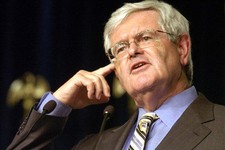
Enthusiasm rose as Newt was introduced as the former Speaker of the House, author of Rediscovering God in America, the Chairman of the Gingrich Group The Gingrich Group, and “a drum major in our march for a better future,” among his other accomplishments. Rock music played as he walked on stage and he was met with a standing ovation and thunderous applause. Ladies and Gentlemen, Newt Gingrich.
You know how in the press club speech we watched, Newt was very good at appealing to both sides, while still maintaining his conservative viewpoints? That was perfect for the National Press club. This speech was also very much tailored to the audience. He showed a lot statistics, most of which are available here. According to his statistics, 86% of all Americans believe there are certain values that unite us all. The statistics he cited mostly involved national defense, taxes, religion, and morality. For example, 85% of Americans believe it is very important to defend American allies. 89% believe religion and morality are important to their family. 64% believe that there is not enough religion taught in school. Only 8% believe that there is too much religion in school, “which” he said, “must be the size of the ACLU.”
Gingrich said that the “elite critics” misunderstand what the argument regarding religion in schools and in the nation is really about. He said he is not advocating theology to be taught in school, just political history. When Thomas Jefferson wrote The Declaration of Independence he did say that we are “endowed by the Creator with certain unalienable rights,” even if he was a deist. Newt also looked at Washington, who was a Christian and Benjamin Franklin, another deist, who called for a day of prayer during the Constitution Convention. Gingrich notes that Lincoln spoke of God fourteen times in the 2nd Inaugural Address, as is written in the Lincoln Memorial. FDR, during his radio talks to the nation asked his listeners to join him in prayer for D-Day.
He did not deny the need for separation of church and state. However, he clarified what he meant by that separation. He said that when Jefferson used the term, he was writing a letter to reassure someone that there would be no compulsory, state-funded religion above the other religions. “Good,” was Newt’s description of the separation of church and state. He doesn’t want the Government funding religion when it, “can’t even fund the Federal Government.”
Newt emphasized that The Constitution says “We the People,” not “We the Lawyers,” and not “We the Politicians.” He said that we lend the politicians our power, it is not theirs to legislate without control. We have the right to fire the politicians that are mishandling power every election.
From a purely political standpoint, Gingrich said very little. Other than mentioning that Immigration should be encouraged (but that the Immigrants need to become Americans and learn English), Newt mostly discussed American history from a Christian perspective.
On the way out of the conference, Newt had people handing out handouts to read the way a teacher does in a class.
To show how well his speech went over at the conference, after his speech—when Newt was signing autographs in his books and taking pictures with his fans, his book sold out completely.
Have We Lost the Edge? long blog post
I suppose it was coincidence or maybe fate, but the topics in the Streitmatter chapter presentations over the past week have coincided with a concert that I attended that got me thinking about political action and debate. The concert was of a band called Umphrey’s McGee (which I had never heard before the concert but decided to go anyways because lets be serious, concerts rock) who played mostly upbeat, jam-band, Phish-style, music and I must say I had a good time. What got me thinking about politics however was a comment that one of the singers made about the lack of political action in DC. It was an innocent comment which was basically a liberal-drenched cliche about Bush being a moron and that we should “Get out of Iraq” and that it was our responsibility based on our geographical position at the time. The comment would have typically rolled right off me, but our classes’ recent discussion of musicians as agents of political change got me thinking.
What Happened?
Where’s our generations Dylan?
Where’s our generations Hendrix?
What are our musicians singing about?
I must admit that I do not listen to much popular-mainstream music anymore (but honestly, does anybody else our age), but I can’t help hearing it in passing every once in a while. What I have heard lately doesn’t even compare to soulful and emotional rendition of “The Star-spangled Banner”, instead it sounds something like a broken synthesizer regurgitating 1980’s top forty hits. It is bothersome that our music has become commodified to the point that there is no longer room for politics or meaningful social issues.
Don’t get me wrong however, I might be blind to a sweeping political music scene that is prominent to everyone but me, but I simply just don’t see it. Sorry. Hear it. Maybe I’m tuning in to tune out, but I can’t see our musicians now-a-days taking a strong political stance on something (sans the Dixie Chicks). Maybe I’m just jaded because I happen to be a fan of classic rock, but I’d like to see our musicians shed their politically apathetic images and start talking to the youth like the musicians of the counterculture revolution on the 60’s.
Long Blog Post-White House Correspondents Event
For my long blog post, I decided to go to the event in Bender Arena that featured a moderated discussion between White House Correspondent David Gregory and Hearst columnist and former White House Correspondent Helen Thomas. The discussion revolved around a debate between the two on whether or not the White House Press Corps had failed the American public in its coverage of the Iraq war, specifically whether or not the hard questions were asked in the reasoning behind the war and if the press had given President Bush a free ride rather than seem anti-American or pro-terrorist.
Helen Thomas took the position that the press corps failed miserably, giving the president carte blanche approval to wage the war in Iraq under false pretenses without the slightest amount of journalistic inquiry or opposition but instead allowing Bush to use the press as an instrument by which to carry his message to the American people unabated and un-scrutinized. Thomas’s stance was one of a virulent and unapologetic ultra-left wing Bush hater. For a good example of her political stance, take a look at one of the columns she has written at http://www.koat.com/helenthomas/8192106/detail.html.
David Gregory, as a current White House Correspondent, tried to remain politically neutral while maintaining that “the hard questions were asked.” For information on Gregory, go to http://www.msnbc.msn.com/id/3688588/.
The debate was a very interesting one, albeit very polarized. In the blue corner we had the unapologetically Bush bashing Thomas and in the red corner we had the neutral and defensive Gregory.
To Gregory’s credit, he made the excellent point of saying that the American people in general and Congress in particular were the ones who truly allowed Bush to invade Iraq. But beyond that, the only point he really seemed capable of making was that “the hard questions were asked.” He also pointed out the niche culture mass media and particularly the internet have created that allows people to hear only the news they want to hear and only from the sources who present in a way they agree with.
Beyond those points however, Gregory said little that was truly substantive and not once did he ever say what questions were asked, only that they were. Truthfully, Gregory’s defense of himself and the journalistic community came across as a very hollow one. His justification of how everyone let Bush get away with Iraq? “The country was in a different place after 9/11.” To add insult to injury, when describing how news gets out, of all the possible sources and stations, newspapers and sites for information, one of the few examples he used for that venue was Fox News.
Thomas was not exactly perfect herself. While I completely agree with her anti-war statements, they came across as so strong that one might wonder if she’s allowed herself to be blinded by her hatred of Bush. And then there was the point she made that while they were not in recent times, the hard questions were asked in Vietnam. Alas, they cut questions short before I could ask how she justified that statement even though the dissident press was decrying the war as early as 1954 while the mainstream didn’t begin anti-war coverage until January and February of 1968 and that coverage was a virtual clone of the arguments the dissident press had been making for a decade or more.
Curious how historical retrospect can change present opinions. Scary as it may seem, press coverage seems to have actually improved since Vietnam. If you take Thomas’s advice and absorb what she says with a grain of salt, the hard questions of Vietnam were asked , but not until 1968. It took 14 years for the mainstream to start against the war back then, it took much less for the modern press to pick up with anti-war coverage. Maybe progress has to come in very small increments over very long periods of time.
I feel obligated to try and tie this whole think back to my group’s particular subject, being candidates positions. As far as that goes, you have to wonder what exactly a candidate or actual elected officials position is on the press. The press can and has been manipulated both here and abroad as both an instrument of support and opposition to those in power. All those running for office want the press to cover them more, and to do so in a positive light. The mark of a good journalist, I think, is how much said journalist allows those men and women to get away with it.
That is not to say journalists should automatically oppose those running for and holding office, only that they should be weary of being anyone’s instrument save for the truth.
Newt Gingrich and subsequently Rick Tyler are of the position that the press should at most serve as time keeper in political debates, that the press coverage should only report, never introduce the topic of discussion. And whether or not the press highlights the topics that aren’t as important as what the candidates want to discuss is a valid question. Other candidates treat the press with a similar attitude, and still others just want them to be carry their message to the masses for assimilation and subsequent support.
Humor Group — Long Blog
I’m really not interested in politics. At all. When I graduate, I plan on moving to New York City and working at a fashion magazine or maybe a travel publication. It’s sad to say, but I pretty much get my news from The Daily Show or the Colbert Report. The humor aspect definitely appeals to me because if these shows weren’t so funny, I probably wouldn’t watch them.
I decided, after talking to Professor Walker, to ask a few friends some questions about what they think about political humor and whether or not it’s important to them. After talking to about fifteen people, I decided that everyone pretty much feels the same: humor is important because it’s what makes politics less about “those guys in Washington” and more real and appealing (quote from one of my roommates).
Most people said that it’s important to understand that these shows are biased. I think that unless you’ve been living under a rock for the past five or so years, you know that The Daily Show, The Colbert Report, South Park, and every other show that involves political humor is slanted toward the left. But yes, after realizing that these shows obviously have a liberal bias, the humor can be appreciated.
One of my other roommates said that humor is important because politicians need to be able to laugh at themselves and take all “the heavy stuff” that’s happening in the world and see the lighter side. I think that shows like The Daily Show certainly do this, but politicians themselves have not really shown their comedic side.
Anyway, I think that shows like the ones on Comedy Central are helping people like me by engaging us in what’s going on in the political world and making an otherwise boring topic much more interesting.
Last Week’s Speaker
Live Blogging of Rick Tyler
Friday, I had an opportunity to be part of a presentation/discussion from Newt Gingrich’s press secretary Rick Tyler. So to fully understand the complexity, I attempted to use a diary type chronically of his time, kind of like what ESPN writer Bill Simmons does for sports games. So without further ado, here is a live diary with some interpretation of the speech:
11:21- introduction of speaker by Professor Dana Walker of American University. Rick Tyler has had success in getting people elected into political positions and host a radio show.
11:24- commences his speech by stating his shock that a press secretary for Newt Gingrich to come onto a college campus.
11:24- posed a question about how we, as college students, obtained their information concerning political information. Tyler stated that in his time he had few sources of news.
11:25-press secretary draws two circles comparing his live and a typical voter’s life. He shaded in most of his circle with the idea that politics takes up most of his life. He then made a tick like dot in the voter’s circle to make the point that they don’t pay much attention to politics.
11:28- Tyler stated that people are weird for watching shows like meet the press and listening to talk radio. Normal people do many other things before watching/listening these things.
11:29-Tyler starts a discussion about the first political debate between Kennedy and Nixon. People thought Kennedy won the debate on television and those who listen to the debate thought Nixon won.
11:31-Tyler posses the question of what is wrong with political debate. One person brought up the idea that candidates are too rigid and lifeless. Another point is that the candidates sound too rehearsed in a debate.
11:32-bring the mood down by talking about how we have many enemies who want to kill us and disrupt our lives. Tyler randomly brings up controlling our borders as a threat to our nation security. Tyler also discusses how we will have to come into struggle with China and India because they have 2 billion more people to work with. Tyler believes that if the US fixes a lot the “-tions”.
11:37- Tyler then asked the audience if they knew anything about social security and how we won’t get any.
11:38-Tyler brings up the point that baby boomers are the most spoiled generation in the history of the United States. He brings up the point that everything eventually goes down in price, except education and health care.
11:40-Tyler discusses the debate system as 9 people from each party lined up like seals waiting for fish from the moderator. He brought up the point that with primary debates, each party looks absolutely crazy from each perspective. Tyler feels a possible solution for this is the Cooper-Union Debate which is to get 2-4 representatives have a 90 min discussion and just talk and have a discussion.
11:44- Tyler brings up the point that the media gets the most talk time and they set the agenda. He implies that media chooses things that sell, but are not what people really wanted to hear about.
11:46-Tyler brings up Mickey Mouse and Donald Duck to describe how certain people will vote a certain part no matter what the situation.
11:48- Tyler brings up the person of the Bundler who can get lots of campaign money to run the campaign which basically wins elections.
11:49- Tyler brings up a point that the most valuable thing people have are thinking and planning time skills. He believes that people are lost and useless without these.
11:51- Tyler brings up the point that the media covers what they want to cover. Tyler also brings up that on 9/11, the media was covering Chandra Levy before 9/11 and how today, the media covered Paris Hilton and Brittney Spears ad nauseam rather then covering stories that are important.
11:55- A question was raised concerning campaign financing and how to fix it and really criticized a potential idea of giving free airtime. He brings up the point that candidates have the least say in their ability to finance campaigns.
11:59- Tyler proposed the idea that we should be more honest in where they get their money from. If a union or a company raises millions of dollars, then that information should be available on the internet for everyone to see it.
12:01- Tyler stated that two people responded to their invitation, Huckabee and Gravelli.
12:02- Tyler states that consultants do not know much about technology and history. How do you explain to people technology that will be outdated and how times will change.
12:05- Tyler brought up how an actual credit/debit transaction works. He uses this point to explain why we are frustrated with the response to Katrina and the length it takes to cash a Medicare check.
12:10- Tyler brings up the point that the private sector is so far ahead of the government sector, it is ridiculous. He brought up the point that voters do not care about the process, just the results. We recently have gotten to the point where we are fed-up with the dissidence between the government and people.
12:13- Tyler brought up the point that if people can communicate well, they will listen for 90 minutes but it will have to be interesting and captivating.
12:14- Tyler brings up the point that there are 39 or 32 pages of debate rules and some of the rules are ridiculous.
12:15- 9 90’s and 9- the idea of having 9 substantive 90 minute debates in the 9 weeks before the election.
12:18- Tyler would never want to see the censoring of speech and when people can campaign. He also liked the idea of using YouTube for debates, but not trivializing it.
12:20- Tyler was asked the question about if opening campaign contributions up the media would not be over played the way it is by having transparency.
12:22- Tyler feels that the media and campaign money determined the downfall of debates i.e. Clinton’s health care proposal. The media covered how it affects Obama rather then what is in the proposal.
12:24- Tyler believes that the candidates actually needs to state what they really are about by using their websites as a main hub for people to discuss. He would then want a compilation and have a blind issue poll and then candidates can then be affected for having a lack of substance on the websites. He believes that it is an idealistic concept, but he is
12:27- Tyler had to defend Newt in not running into the race. Ted Kennedy was asked why he wanted to be president and Kennedy had not real reason to be president. He also brought up how Giuliani talked about money raising when the host said hello and welcome and how were things going.
12:31- Tyler brings up to the point that people customizing how and where they are consuming their news. So two people in the same house can consume two completely different styles of news
12:33- “Slogans are fine if they have substance in them.”
Who’s watching?
For my first long blog post I’ve decided to crunch some numbers. Yeah I know, it doesn’t sound so exciting at first. But I was curious to see how good (turns out I should say “how bad”) viewership among the American people is today, and also the trends that presidential debate viewership have been taking since the 60’s when the televised debate was first introduced. The Commission On Presidential Debates has records on viewership numbers going all the way back to Kennedy and Nixon.
Things started out OK. The four televised debated in the 1960 general election drew an average viewership 63.1 million people per debate. At the time, this averaged out to be nearly 35 percent of the population watching each debate. Viewership percentages fell slowly, and not too alarmingly through the 70’s and 80’s. In 1988 an average of 27.5 percent of the population tuned in each night.
The year America changed the channel appears to be 1996. An average of 41.2 million people watched the debates, that’s a population average of only 15.5 percent at the time. Numbers from 2000 show that viewership was continuing to slow.
One thing I noticed in looking at all this was that Americans tuned in their greatest numbers for the 1960 debates between Kennedy and Nixon, and 1960 was the only election year to feature 60 minute debates. Every year after that the debate time was increased to 90 minutes. Is it possible that working Americans just don’t have those 90 minutes in their day to spare?
Early projections of viewership in 2008 don’t look too promising. The highest rated debate thus far has been Fox News Channel’s Republican debate in New Hampshire, which was seen in 2.47 million households. Debates held on CNN and MSNBC have fared worse.


 M. Appeal (Mass Appeal)